

- Hospice or palliative care: what is the difference?
- Who provides hospice and palliative care in Malaysia?
- Find a home hospice in your state
- How home hospice care works
- Where a private caregiver fits between hospice visits
- Preparing the home
- Looking after yourself as the family carer
- When to call the doctor or palliative team
- What you can do this week
- Sources
Specialist Care
Hospice and Palliative Care at Home in Malaysia

Martin Yap
Founder & CEO
Tags
Synopsis
Hospice and palliative care at home in Malaysia: a home hospice finder by state, how referral works, what it costs (mostly free) and who helps between visits.
Related Articles
Specialist Care
Post-Stroke Care at Home in Malaysia - Family Guide
Home Care Guide
Home Care Services in Malaysia - The Complete Guide (2026)
Home Care Guide
Elderly Care at Home in Malaysia - A Family Guide
Care Decisions
Home Care vs Nursing Home in Malaysia: How to Decide
Hiring & Caregivers
How to Find a Caregiver in Malaysia - A Family Guide

Hospice care at home in Malaysia mostly comes from community hospices: charity teams of nurses and doctors who visit your parent at home. Most are free, and the first step is to ask your parent's doctor about a referral. Hospital palliative teams and some government clinics also provide palliative care. Between visits, family or a caregiver you arrange gives the daily care, following the team's plan.
This guide is general information only. Your parent's doctor or palliative team knows their condition, and their advice comes first.
Home hospice care in Malaysia at a glance
- Who provides it
- Community hospices, hospital palliative care teams and selected Klinik Kesihatan
- What it costs
- Usually free from a community hospice. Private caregivers and nurses are paid.
- How to start
- Ask your parent's doctor for a referral to the hospice that covers your area
- How often they visit
- Typically once every two to four weeks, more often when needed
- What they expect
- A main carer at home, usually a family member
- Between visits
- Family, or a part-time or live-in caregiver, gives the daily care
Hospice or palliative care: what is the difference?
In Malaysia the two words mostly describe the same care. The Malaysian Hospice and Palliative Care Council (MHPCC) explains that some countries use "hospice" for home or volunteer services and "palliative care" for hospital teams, but the principles of care are the same. Here, most community palliative teams are called hospices or palliative care associations, and most of their work is visiting families at home. So a hospice in Malaysia is usually a team that comes to your parent, rather than a place your parent moves into.
Care in the final days or weeks is often called end-of-life care. It is one part of palliative care. Palliative care puts comfort and quality of life at the centre of the plan, at any stage of a serious illness.
The World Health Organization (WHO) describes palliative care as an approach that improves the quality of life of people facing a life-threatening illness, and of their families, by preventing and relieving pain and other physical, emotional and spiritual problems. WHO and MHPCC also make four points:
- It can start early. WHO says palliative care is most effective when considered early in the illness. MHPCC notes it can run alongside treatment intended to prolong life, such as chemotherapy or radiation therapy.
- It is not only for cancer. WHO lists heart disease, chronic lung disease, kidney failure, dementia and Parkinson's disease among the conditions where palliative care is needed, and calls the belief that it is only for cancer, or only for the last weeks of life, a misconception.
- It neither hastens nor delays death. MHPCC, citing WHO, says palliative care intends neither to hasten nor postpone death, and regards dying as a normal process.
- It includes the family. WHO describes a team approach that supports caregivers too, including practical needs and bereavement counselling.
Who provides hospice and palliative care in Malaysia?
| Who | What they do | How to start |
|---|---|---|
| Community hospice | Home visits by nurses and doctors, symptom advice, carer training, equipment loans | Usually a doctor's referral |
| Hospital palliative care team | Specialist assessment, symptom control and care planning, on the ward and in clinic | Ask your parent's hospital doctor |
| Klinik Kesihatan (selected sites) | Community palliative care through home visits | Ask your nearest government clinic |
| Private home care | Daily hands-on care and nursing tasks, part-time or live-in | Contact the provider for an assessment |
Community hospices are charities. MHPCC counts 30 NGO hospice organisations, in every state except Perlis, and most provide home care. It describes their home programmes as a free service that depends on public donations and needs a primary carer at home.
Hospital palliative care teams work in many Malaysian hospitals, usually led by a palliative medicine specialist with medical officers, nurses and allied health professionals, according to MHPCC. If your parent is in hospital, ask the ward doctor whether the palliative team can see them before discharge.
Klinik Kesihatan community palliative care started in 2016, when the Ministry of Health extended the home visit (domiciliary) services of certain clinics to include palliative care where NGO services do not meet the need, according to MHPCC. It is available at selected sites only, so ask your nearest clinic.
Private home care providers supply caregivers and nurses part-time or live-in. They give the hands-on daily care that the visiting teams do not, and they charge for it.
Find a home hospice in your state
The finder lists 14 community hospices that visit people at home. For each one it shows the area served, who it takes, how to start, the cost and its phone number, all taken from the hospice's own website on 14 October 2026.
Most home hospice care in Malaysia is free, and the first step is to ask your parent's doctor about a referral.
11
of 14 with free home care
7
of 14 that require a doctor's referral
Of the 14 hospices in the finder, 11 say their home care is free and 7 require a doctor's referral. Each block is one hospice.
Find a home hospice by state
Community hospices that send a care team to your parent's home. Choose a state to narrow the list.
11 of the 14 hospices in this finder say their home care is free, and 7 ask for a referral from a doctor. Whichever hospice you choose, start by asking your parent's doctor about a referral.
Hospis Malaysia
Kuala Lumpur and Selangor
- Area served
- Klang Valley. Call to check that your area is covered; families outside it can use its outpatient clinic in Cheras.
- Who it is for
- People with a life-limiting illness
- How to start
- Referral from a doctor, on its online or printed form
- Cost
- Free. It also lends equipment at no charge and runs a 24-hour emergency line for registered families.
Checked on its website, 14 October 2026
Kasih Hospice Foundation
Kuala Lumpur and Selangor
- Area served
- Kepong, Jinjang, Segambut, Bandar Sri Damansara, Selayang and Batu Caves, Sungai Buloh and Rawang, with some exceptions. Its page also shows parts of Shah Alam and Serendah, so check its list.
- Who it is for
- Stage 4 cancer and end-stage kidney failure
- How to start
- Your parent's doctor fills in its referral form and emails it
- Cost
- Free
Checked on its website, 14 October 2026
Assisi Palliative Care (AsPaC)
Kuala Lumpur and Selangor
- Area served
- Up to 40 km from its centre in Petaling Jaya
- Who it is for
- Advanced cancer and progressive illnesses other than cancer
- How to start
- Referral from the attending doctor
- Cost
- Free
- Contact
- 03-7783 8833aspac.my
Checked on its website, 14 October 2026
Faith Hope Love Hospice Care (FHL Hospice)
Kuala Lumpur and Selangor
- Area served
- Klang Valley
- Who it is for
- Life-limiting illnesses such as stage 4 cancer and heart failure
- How to start
- Referral from a registered doctor, on its doctors-only form
- Cost
- Free. Equipment loans need a refundable deposit.
- Contact
- 010-393 0150fhlhospice.org
Checked on its website, 14 October 2026
Hospice Klang
Selangor
- Area served
- Klang and its community
- Who it is for
- Life-limiting illnesses, including organ failure
- How to start
- A doctor, family member or carer can refer. The form asks for the referring doctor's details and recent reports.
- Cost
- Free
- Contact
- 03-3318 4774hospiceklang.org
Checked on its website, 14 October 2026
Penang Hospice Society
Penang
- Area served
- Penang Island and Seberang Perai, from offices in George Town and Bukit Mertajam
- Who it is for
- Anyone living in Penang who needs palliative care
- How to start
- Hospitals, doctors or family can refer. Its referral form is recommended.
- Cost
- Free. Equipment loans need a refundable deposit.
Checked on its website, 14 October 2026
Charis Hospice
Penang
- Area served
- Penang Island
- Who it is for
- Advanced life-threatening illnesses
- How to start
- Referral from a doctor
- Cost
- Free
- Contact
- 04-827 9668charishospice.com
Checked on its website, 14 October 2026
Perak Palliative Care Society
Perak
- Area served
- Ipoh
- Who it is for
- Advanced cancer, with a carer at home
- How to start
- Family can register at its centre or by email, preferably with a doctor's letter
- Cost
- Free
- Contact
- 05-546 4732ppcs.org.my
Checked on its website, 14 October 2026
Pertubuhan Hospice Negeri Sembilan
Negeri Sembilan
- Area served
- Throughout Negeri Sembilan, from Seremban
- Who it is for
- People who are terminally ill
- How to start
- Online referral form on its website
- Cost
- Free. It also lends wheelchairs, commodes, beds and oxygen concentrators.
- Contact
- 06-762 1216phns.org.my
Checked on its website, 14 October 2026
Hospis Melaka
Melaka
- Area served
- Not stated on its website. It is based in Ayer Keroh.
- Who it is for
- Advanced cancer
- How to start
- Online referral form. Call before visiting the centre.
- Cost
- Not stated. Its website says public donations and government grants fund its services.
- Contact
- 06-234 4554hospismelaka.org
Checked on its website, 14 October 2026
Palliative Care Association of Johor Bahru
Johor
- Area served
- About 25 to 30 km around Johor Bahru (its website gives both)
- Who it is for
- Cancer
- How to start
- Referral from a registered doctor
- Cost
- Free
Checked on its website, 14 October 2026
YOKUK
Kelantan
- Area served
- Across Kelantan, with mobile home visit teams
- Who it is for
- Bedridden people with cancer, stroke and other life-limiting illnesses
- How to start
- Not stated on its website. Call to ask.
- Cost
- Not stated on its website
- Contact
- 09-774 3033yokuk.org
Checked on its website, 14 October 2026
National Cancer Society Malaysia, Sarawak Branch
Sarawak
- Area served
- Within 20 km of its office in Kuching
- Who it is for
- Terminally ill cancer
- How to start
- Its home care referral form, sent by email, fax or phone message
- Cost
- Free
Checked on its website, 14 October 2026
Palliative Care Association of Miri
Sarawak
- Area served
- Within 50 km of Miri
- Who it is for
- Terminally ill cancer
- How to start
- Referral letter from a hospital or clinic doctor
- Cost
- Not stated on its website
Checked on its website, 14 October 2026
Care Concierge home care does not cover Sarawak. For a residence in Kuching, see Care Collective, part of the Care Concierge group.
Check two things before you call: whether your parent lives inside the service area, and whether the hospice accepts people with your parent's illness. Several hospices take only people with advanced cancer. If no hospice covers your area, ask the hospital palliative team or your nearest Klinik Kesihatan.
How home hospice care works
Each hospice sets its own steps, but the published steps follow the same pattern.
From referral to daily care
Step 1
Referral
Usually your parent's doctor fills in the hospice's form. Some hospices also accept a request from the family.
Step 2
Assessment at home
The team visits, assesses your parent and agrees the care plan with the family.
Step 3
Regular visits
Typically every two to four weeks, more often when your parent needs it.
Step 4
Daily care in between
Family or a caregiver follows the plan, with training and equipment from the hospice.
- Referral. Usually your parent's doctor completes the hospice's referral form, though some hospices also accept a request from the family. Hospis Malaysia aims to contact the family within two working days of accepting a referral, and Kasih Hospice Foundation within 48 working hours if it accepts the case.
- Assessment at home. The team's first visit assesses your parent at home. The National Cancer Society's Sarawak team, for example, starts every new case this way.
- Regular visits. MHPCC says visits are typically once every two to four weeks. The Palliative Care Association of Miri visits registered families every two weeks, and Hospis Malaysia's visits range from occasional check-ins to daily support, depending on your parent's condition.
- Daily care in between. Hospices teach the family carer, and many lend equipment such as hospital beds, wheelchairs and oxygen concentrators. Hospis Malaysia also runs a 24-hour emergency line for families under its care.

Where a private caregiver fits between hospice visits
Hospice visits are scheduled, often weeks apart, and hospices expect a main carer at home to give the daily care in between. A private caregiver can take on that daily care. The hospice still plans the medical care, and the caregiver follows that plan day to day, so the family does not carry every hour alone.
Who does what at home
Hospice team
Assesses symptoms, adjusts medicines, agrees the goals of care, trains carers and lends equipment.
Private caregiver
Bathing, turning in bed, help at meals, medicine reminders, company, and cover for the hours family cannot manage.
Family
Decides with your parent, stays the hospice's main contact, and spends time together as family.
The hospice or palliative team (doctors, nurses and therapists) assesses symptoms, prescribes and adjusts medication, agrees the goals of care with your family, trains carers and advises what to do when things change.
A home caregiver works within that plan:
- Personal care. Bathing, mouth care, toileting and changing, done gently and with privacy.
- Repositioning and pressure care. Turning your parent in bed as often as the nurse advises, and checking the skin over the hips, heels and lower back for redness.
- Feeding support. Following the team's feeding and swallowing advice. If your parent coughs, chokes or becomes drowsy while eating, stop and ask the team before offering more.
- Medication reminders. Reminders and a written record, exactly as the doctor prescribed. A caregiver never changes a dose.
- Comfort and companionship. Sitting with your parent, reading to them, playing their music, keeping the room calm.
- Time for the family. Agreed care hours so you can sleep, work or rest.
Some tasks need a nurse, such as wound dressing, suctioning and giving certain medicines. Our guide to home nursing care in Malaysia explains what nurses handle at home, and our guide to home care services in Malaysia covers the other kinds of help.
Typical market rates for private help in Malaysia, checked in October 2026, are RM30 to RM55 an hour for a trained part-time caregiver in the Klang Valley (from RM24 in Penang), and RM3,700 to RM6,500 or more a month for a live-in caregiver. Our guide to the cost of home care in Malaysia explains each tier.
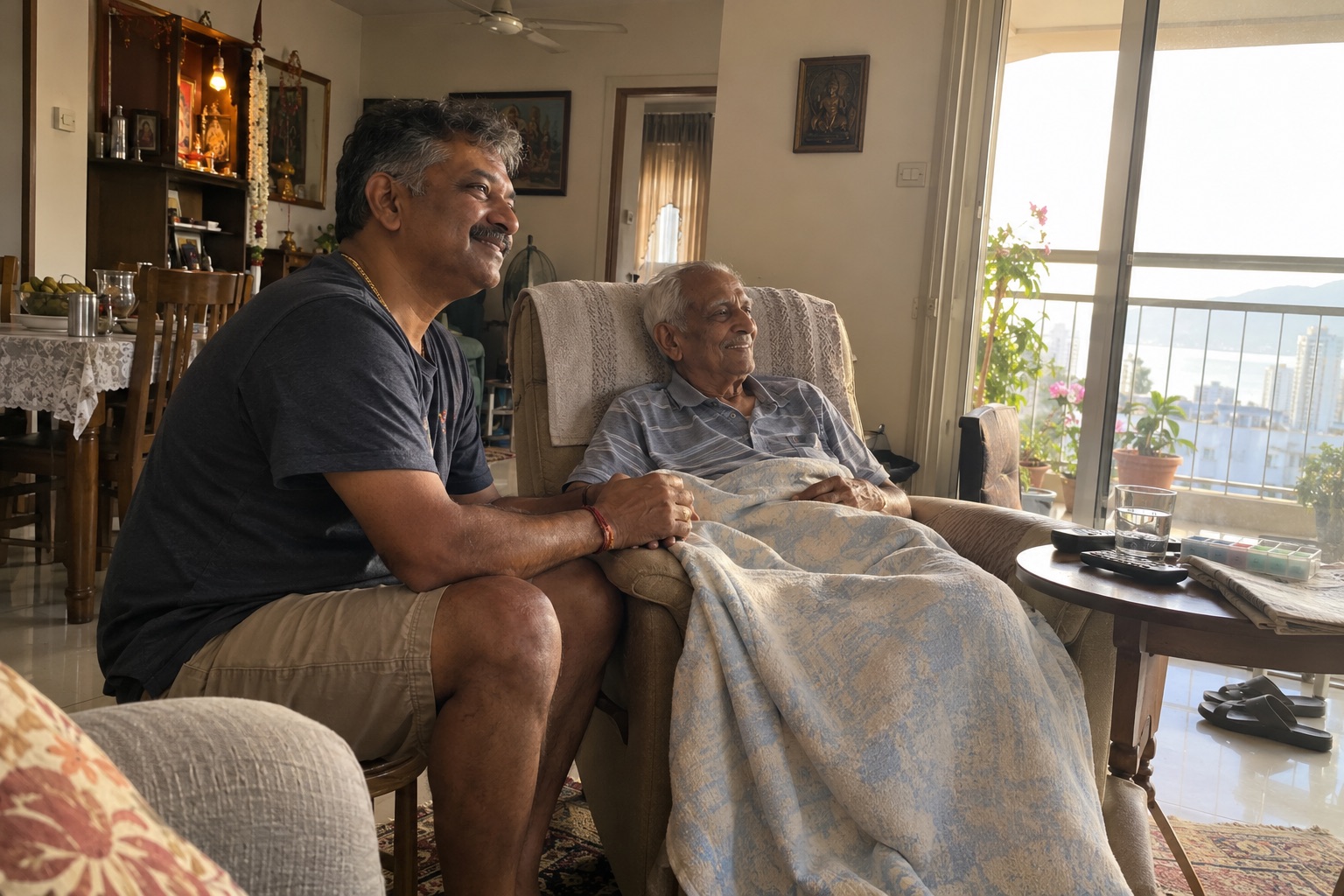
How Care Concierge supports palliative care at home
Care Concierge gives daily care at home alongside your parent's doctors and hospice team, so your parent can stay in familiar surroundings with comfort and dignity.
- A plan built around your parent. Care starts with an assessment of your parent's medical and emotional needs. We ask what matters most to them, such as comfort, daily routines and personal wishes, and plan the care around it.
- A team behind each caregiver. Our caregivers look after people receiving palliative care at home. A team of nurses, care coordinators and therapists oversees the plan and adapts it as needs change, and a Senior Care Manager coordinates each family's care.
- Live-in or part-time. A live-in caregiver stays in the home and gives up to 10 hours of active care a day. Part-time caregivers or registered nurses can visit for set hours instead.
- Nursing and medical support. A qualified nurse may provide agreed procedures such as wound dressing and medication administration, within the treating team's instructions and the nurse's scope. Ask which tasks need a nurse, which can be taught to the family, and who will provide them. We also offer doctor house calls, physiotherapy and a medical chaperone for hospital appointments.
- Support for the family. We train family members in basic care and safe transfers, and guide you through difficult decisions.
Our home care covers Penang, Perak, Kuala Lumpur, Selangor, Melaka, Negeri Sembilan and Johor. We adjust the schedule and level of support as your parent's symptoms and energy, and your family's needs, change.
Preparing the home
Choose the room. A ground-floor room near a bathroom saves stairs for everyone. Leave space on both sides of the bed for turning and transfers.
Ask before you buy equipment. A hospital bed, pressure-relieving mattress, commode, wheelchair or oxygen may help. Ask the palliative team what your parent needs first. Many hospices lend equipment, some for a refundable deposit.
Keep everything in one place. Put the medication list, the care plan, the latest discharge summary and the team's phone numbers in one folder by the bed, and show anyone covering a shift where it is.
Reduce the risk of falls. Clear loose rugs and cables, add a night light, and fit a grab bar in the bathroom.
Make it theirs. Bring in photos, familiar bedding and a radio, and give them a view of the garden if you can.
Looking after yourself as the family carer
Caring for a parent with a serious illness is tiring, in body and mind. Palliative care includes you: WHO describes it as support for the family as well as the person who is ill.
- Share the load early. Agree among siblings who handles nights, appointments and money. Write it down.
- Learn the basics. Hospice carer training and our family training cover safe transfers and daily care, so you worry less about hurting your parent.
- Plan your rest. MHPCC notes that community hospices rely on hospitals when the primary carer at home needs respite. Arrange breaks before you reach that point, with family, a part-time caregiver or a live-in caregiver. Our guide to live-in caregivers in Malaysia explains how that arrangement works.
- Say when you are not coping. Tell the palliative team early, so they can help.
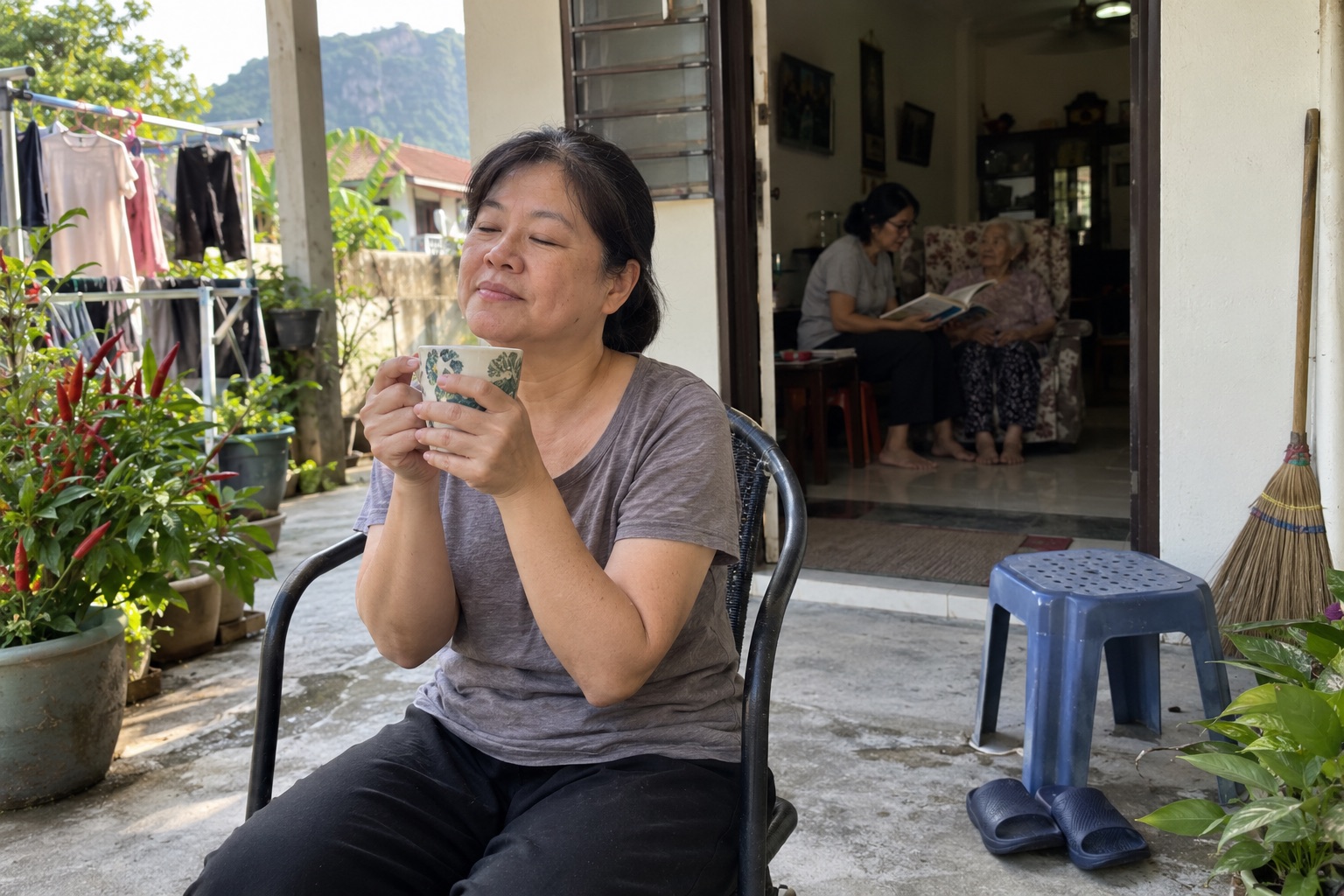
Getting help isn't giving up. It gives you more time to be your parent's child as well as their carer.
When to call the doctor or palliative team
Your parent's care plan should say who to call and when, including after hours. Follow it. As general guidance, NHS palliative care information for families caring at home advises getting advice from the nurses or palliative team when:
you are concerned about pain, breathlessness, noisy chest secretions or agitation
your parent's condition changes more quickly than expected
your parent falls. Do not try to lift them on your own.
you are worried you are not coping
Keep the doctor's and hospice's numbers by the bed and on every carer's phone. Ask the treating team to write down when to use its after-hours number and when emergency services are needed, in line with your parent's agreed care plan. This article does not replace that plan.
What you can do this week
- Find the hospice for your area. Use the finder above, check the service area, and ask your parent's doctor to send the referral.
- Talk about what matters to your parent. Ask where they want to be cared for, who they want around them and what comfort means to them.
- Map the hours. List the care your parent needs across a day and night, then mark which hours family can cover.
- Fill the gaps. Arrange part-time or live-in care for the hours family cannot cover, and agree with the hospice team what each person will do.
Once you know when the hospice will visit and which hours family can cover, a Care Advisor can suggest a caregiver or nurse schedule for the rest and give you a personalised quote. There is no pressure and no obligation. When you're ready, we're here.
Need help with the hours between hospice visits?
Sources
- WHO: Palliative care
- MHPCC: Palliative care explained
- MHPCC: Hospice care in Malaysia
- MHPCC: Member hospices by state
- Hospis Malaysia: Patient services
- Hospis Malaysia: FAQs
- Kasih Hospice Foundation: Our services
- National Cancer Society Malaysia, Sarawak Branch: Palliative home care
- Palliative Care Association of Miri: Home programme
- St George's NHS: Caring for someone at home
- Homage: Care plans (hourly rates)
- Jasper Lodge: Home care services in Kuala Lumpur (30 January 2026)
- WhereWeCare: Pricing
- FaMGuard@Home: Rates
- Care Concierge: Palliative care at home
Dive Deeper
Specialist Care
Post-Stroke Care at Home in Malaysia - Family Guide
Your parent had a stroke and is coming home. Here's what to prepare, what care they'll need, and how home care supports stroke recovery in Malaysia.

Home Care Guide
Home Care Services in Malaysia - The Complete Guide (2026)
Everything Malaysian families need to know about home care - services, costs, how to choose a caregiver, and what to expect. Updated for 2026.
Home Care Guide
Elderly Care at Home in Malaysia - A Family Guide
Considering caring for your elderly parent at home in Malaysia? Here's what it involves, when to get help, and how to make it work.
Care Decisions
Home Care vs Nursing Home in Malaysia: How to Decide
Home care or a nursing home? Take the four-question check, compare care side by side, and see typical Malaysian costs for each, checked October 2026.
Hiring & Caregivers
How to Find a Caregiver in Malaysia - A Family Guide
Looking for a caregiver in Malaysia? Here's how to find, evaluate, and hire the right caregiver for your elderly parent - from agencies to freelance.