

Care Decisions
Caregiver vs Maid for Elderly Care
Why Hiring a Helper Isn't the Same

Martin Yap
Founder & CEO
Tags
Synopsis
Every Malaysian family's first instinct is to hire a maid when a parent starts slowing down. Here's when that works - and when it doesn't.
Related Articles
Care Decisions
Home Care vs Nursing Home in Malaysia: How to Decide
Care Decisions
How to Choose a Nursing Home in Malaysia
Care Decisions
Elderly Day Care in Malaysia: 2026 Fees, Centres
Home Care Guide
Home Care Services in Malaysia - The Complete Guide (2026)
Home Care Guide
Elderly Care at Home in Malaysia - A Family Guide
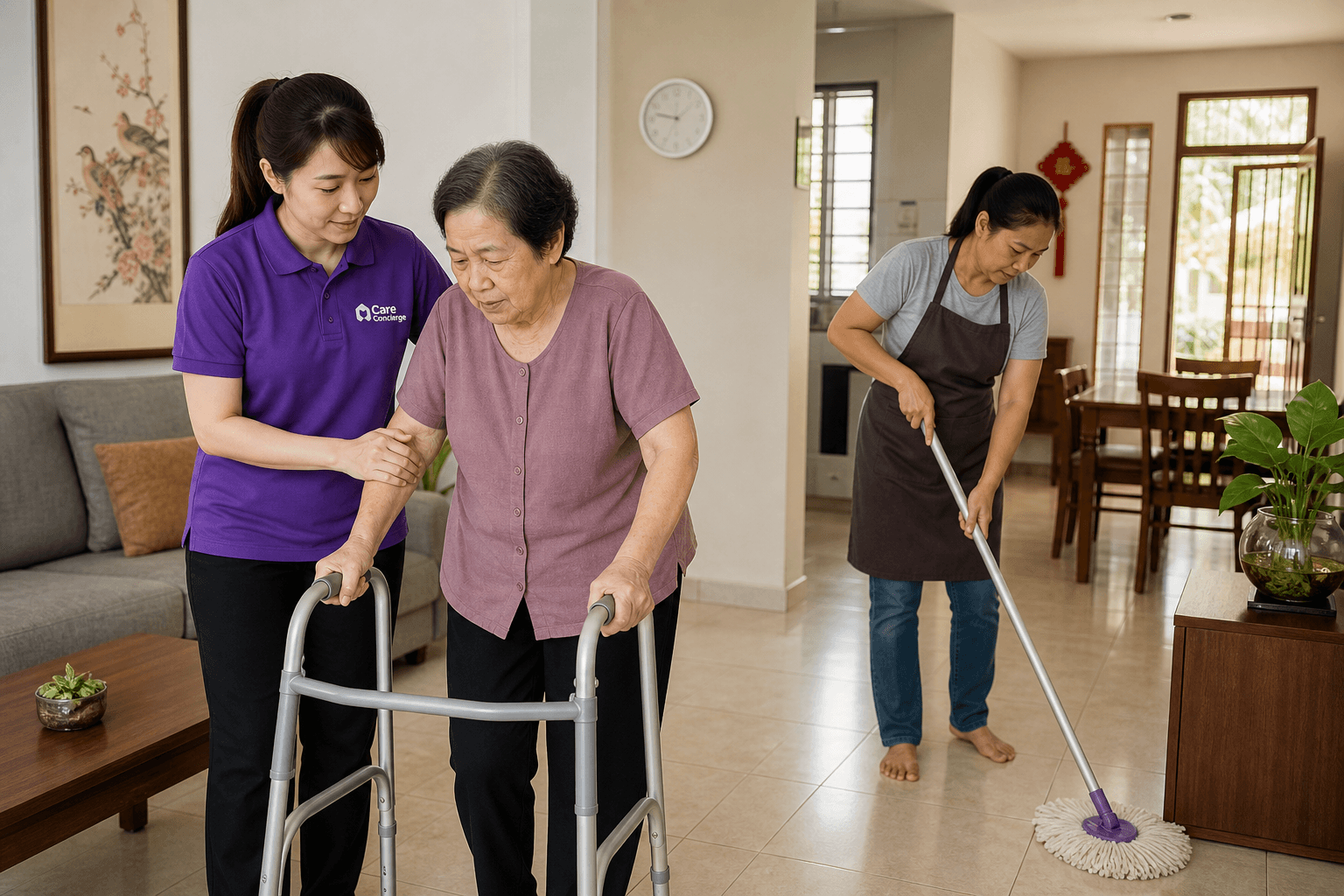
Every Malaysian family's first instinct is to hire a maid when a parent starts slowing down. It makes sense - until it doesn't.
Your mother had a fall last month. Or your father's memory is slipping. Maybe a sibling called to say, "Someone needs to be with Ah Ma during the day." The natural response? Call the maid agency. It's what most Malaysian families do - and for a while, it works.
But there's a growing gap between what domestic helpers are trained to do and what ageing parents actually need. If you're exploring home care services in Malaysia, understanding that gap could be the most important thing you read this year.
If you're also considering a residence, our guide to home care vs nursing home sets out how families decide.
This article isn't about criticising maids or the families who rely on them. Many of us grew up with live-in helpers who became part of the family. This is about knowing when general household help is enough - and when your parent needs something more.
Caregiver vs Maid - The Key Differences
The terms "maid" and "caregiver" are often used interchangeably in Malaysia. They shouldn't be. Here's a side-by-side comparison of what each role actually involves:
| Factor | Domestic Helper (Maid) | Professional Caregiver |
|---|---|---|
| Training | General housework orientation; no formal elderly care certification | Certified in elderly care (e.g., through UTAR-partnered programmes), with ongoing supervision |
| Medical knowledge | None required | Trained to recognise warning signs - stroke symptoms, blood pressure changes, skin breakdown, infection indicators |
| Medication management | May help remind, but not trained to manage complex regimens | Trained in medication scheduling, dosage tracking, and monitoring for side effects |
| Fall prevention | Limited awareness | Trained in mobility assistance, transfer techniques, and home safety assessment |
| Emergency response | Likely to panic or call family first | Trained in first-response protocols - knows when to escalate, what to document, and how to stabilise |
| Supervision | Works independently; employer manages directly | Part of a care team with a dedicated coordinator who monitors care quality |
| Cost | RM1,200–2,000/month (plus levy, agency fees, food, accommodation) | Higher monthly cost, but includes professional oversight, care planning, and accountability |
| Primary role | Housework, cooking, cleaning - with caregiving added on | Elderly care is the entire job - every skill is built around your parent's wellbeing |
This table captures the core difference: a domestic helper is hired for the household. A professional caregiver for elderly care is hired specifically for your parent.
When a Maid Can Handle It
Let's be honest - not every ageing parent needs a professional caregiver. For many families, a good domestic helper is exactly the right choice.
A maid can work well when your parent is:
- Still mobile and independent - able to walk, bathe, and use the bathroom without assistance
- Cognitively sharp - no signs of dementia, confusion, or wandering
- On simple medication - one or two daily pills, no complex schedules or injections
- Socially engaged - still goes out, sees friends, attends family gatherings
- Needing companionship more than care - someone to cook meals, keep the house tidy, and be present during the day
In these situations, a domestic helper provides exactly what's needed: a reliable, caring presence in the home. Millions of Malaysian families make this work every day, and there's nothing wrong with it.
The problems start when the situation changes - and it almost always does.
When a Maid Can't
There are specific tipping points where a domestic helper's role becomes genuinely unsafe - not because they don't care, but because they're not equipped for what the situation demands.
Watch for these scenarios:
Medication errors
Your parent is now on five or six medications - blood thinners, diabetes medication, blood pressure pills - with different dosages at different times. A single missed dose or accidental double dose can mean an emergency room visit. Medication management isn't a task you learn on the job.
Falls and mobility decline
Your parent has started using a walker, or needs help getting out of bed. Improper transfer techniques don't just risk a fall - they risk fractures, head injuries, and a spiral of hospitalisation that many seniors never fully recover from. A trained caregiver for elderly parents knows how to assist with transfers safely, every time.
Post-surgical recovery
After a hip replacement or heart surgery, your parent needs wound care, physiotherapy exercises, and careful monitoring for complications. A maid watching YouTube tutorials isn't a care plan.
Dementia and wandering
Your parent has started leaving the house confused, forgetting the stove is on, or not recognising family members. Dementia care requires specific training - redirection techniques, safety protocols, and the patience that comes from understanding the condition, not just dealing with its symptoms.
Palliative or end-of-life care
When a parent's condition is terminal, the level of care - managing pain, maintaining dignity, supporting the family emotionally - goes far beyond anything a domestic helper should be expected to handle.
If you're seeing any of these signs, it may be time to find a professional caregiver in Malaysia who is trained specifically for what your parent needs.
Not sure if your parent's current arrangement is still safe? Get a professional assessment.
The Real Cost Comparison
On paper, a maid looks far more affordable. And in raw monthly terms, she is.
Domestic helper costs (typical):
- Monthly salary: RM1,200–2,000
- Agency fee: RM8,000–15,000 (one-time, amortised over contract)
- Annual levy: RM410
- Food, accommodation, utilities: RM300–500/month
- Effective monthly cost: RM1,800–2,800
Professional caregiver costs:
- Higher monthly rate (varies by provider and care level)
- Includes training, supervision, care coordination, and accountability
- No separate levy, agency, or accommodation costs in most models
The gap narrows more than most families expect. But the real calculation isn't about monthly cost - it's about risk.
What a single fall costs:
- Ambulance and A&E visit: RM500–2,000
- Hip fracture surgery: RM15,000–40,000
- Rehabilitation: RM3,000–8,000/month for 3–6 months
- Extended hospitalisation: RM500–1,500/day
One preventable fall can cost more than a year of professional caregiving. One medication error can trigger a hospital admission. These aren't hypothetical scenarios - they're the calls families receive every week.
For a deeper breakdown, see our guide on the cost of home care in Malaysia.
A Common Malaysian Story
This story isn't about one family - it's a pattern we see again and again.
Ah Kau's children hired Wati, an Indonesian helper, when their father started needing company during the day. Wati was wonderful. She cooked his favourite meals, kept the house clean, and sat with him when he watched TV in the evenings. For two years, it worked perfectly.
Then Ah Kau was diagnosed with early-stage vascular dementia. At first, it was small things - repeating questions, misplacing his wallet, forgetting he'd already eaten. Wati adapted. She reminded him gently, labelled the drawers, hid the extra set of house keys.
But the condition progressed. Ah Kau started waking at 3am, convinced he needed to go to work. He left the gas stove on twice. He became agitated when Wati tried to redirect him - something she'd never been trained to handle. One morning, he walked out the front gate in his pyjamas and was found by a neighbour three streets away.
The family scrambled. They called their maid agency - no help there. They searched Google at midnight. They asked in Facebook groups. Within a week, they'd engaged a professional care team with a dedicated coordinator who assessed Ah Kau's condition, developed a care plan, and placed a trained dementia caregiver in the home.
Wati stayed on for housework. The caregiver handled Ah Kau's care. The family finally slept through the night.
The point isn't that Wati failed - she didn't. She was simply asked to do a job she was never trained for.
What You Can Do Right Now
You don't need to make a dramatic decision today. But if anything in this article resonated, here are practical steps you can take this week:
- Assess honestly. Look at your parent's current condition - not where they were six months ago. Are they declining? Are there new risks the current arrangement can't address?
- Talk to your siblings. Care decisions made alone create resentment. Share this article with your family and start the conversation together.
- Don't fire the maid. If you do bring in professional care, your helper can continue doing what she does well - cooking, cleaning, companionship. Many families run both arrangements side by side.
- Get a professional assessment. A proper care assessment - conducted by trained professionals, not a sales team - can tell you exactly what level of care your parent needs. No obligation, no pressure.
- Ask the right questions. When evaluating any care provider, ask: Are your caregivers certified? Who supervises them? What happens in an emergency? What's included in the cost?
Take the First Step
Care Concierge provides trained, supervised caregivers through a concierge-style model - with a dedicated coordinator for every family. Our caregivers are certified through a UTAR-partnered academy, and every care plan is built around your parent's specific needs.
If you're not sure whether your parent needs professional care, start with a conversation. No commitment, no hard sell - just honest guidance from people who understand what your family is going through.
Explore our home care services
Or if you'd prefer to chat directly, reach out to us on WhatsApp - we typically respond within a few hours.
Dive Deeper
Care Decisions
Home Care vs Nursing Home in Malaysia: How to Decide
Home care or a nursing home? Take the four-question check, compare care side by side, and see typical Malaysian costs for each, checked October 2026.

Care Decisions
How to Choose a Nursing Home in Malaysia
How to choose a nursing home or retirement home in Malaysia: match the care level, check JKM and Ministry of Health registration, and use our visit checklist.
Care Decisions
Elderly Day Care in Malaysia: 2026 Fees, Centres
Elderly day care in Malaysia costs about RM70 to RM180 a day at centres that publish rates. See a typical day, who it suits, dementia care and free JKM centres.
Home Care Guide
Home Care Services in Malaysia - The Complete Guide (2026)
Everything Malaysian families need to know about home care - services, costs, how to choose a caregiver, and what to expect. Updated for 2026.
Home Care Guide
Elderly Care at Home in Malaysia - A Family Guide
Considering caring for your elderly parent at home in Malaysia? Here's what it involves, when to get help, and how to make it work.